
Why Students “Lose Motivation” and Learning Goals Fall Apart
Many adult language learners start strong and fade early. This article breaks down why that happens and shows teachers how to design clearer, more sustainable goals that support persistence, practice, and real progress in language learning.
TEACHING
Olia Tomski
1/31/20265 min read


Have you noticed how often this happens?
Students start the term energized.
They talk about doing better this term, scoring higher on assessments, or participating more in class.
They show up consistently… until they don’t.
They start skipping classes and not turn in their assignments.
Eventually, many learners drop out.
It is tempting to explain this away as a lack of motivation or that life gets lifey. But after watching this pattern repeat year after year, it becomes clear that something else is happening much earlier in the process.
In many cases, learners disengage not because they stop caring, but because their mental system decides the effort is not sustainable.
To see why, it helps to step away from our classrooms for a moment.
Think about your own New Year’s resolutions.
One you followed through on, and one you abandoned.
Hold those in mind as we walk through three research-backed goal-setting strategies that help learners persist longer and practice more consistently.
Strategy 1
Help Learners
See a Clear Path Forward
Researchers at NYU studied how people approach tasks that require sustained effort. They found that when individuals could identify a clear endpoint before starting, several things changed.
Their brains interpreted the task as less demanding.
Their bodies prepared for effort more efficiently.
Their performance improved, even when the task itself was difficult.
Nothing about the work changed. Only the structure around it did.
This matters because many language learners are asked to work toward goals that are extremely broad.
Improve English.
Practice speaking.
Build vocabulary.
These intentions sound reasonable, but they offer no concrete reference point for the brain. When the next step is unclear, effort feels heavier than it actually is. Over time, that sensation becomes exhausting.
As teachers, we often underestimate how much mental energy ambiguity consumes.
When goals are broken into visible, smaller actions, learners are more likely to follow through. Each step then feels achievable and -progress measurable. Effort feels manageable.
In practical terms, this means shifting from abstract aims to sequences of actions. Instead of asking learners to improve speaking, we help them identify exactly what they will practice, how often, and in what context.


Strategy 2
Make Consequences Clear Not Threatening
Positive visualization has its place, but it is not always enough to sustain habits.
Research on behavior change shows that people are more likely to stick with routines when they clearly understand what happens if they do nothing.
For learners, this does not mean fear-based messaging or negativity. It means clarity.
If vocabulary is not reviewed, it fades.
If practice is avoided, skill development does not happen on its own.
If feedback is ignored, errors become habits.
Effective goal design does not require dramatic warnings or pressure. It requires making cause-and-effect relationships visible.
Teachers already do this well in other areas. We clarify expectations. We reduce uncertainty. We explain how actions connect to outcomes.
When learners understand the cost of inaction in concrete terms, effort feels purposeful rather than optional.


Strategy 3
Shift the Focus From Outcomes
to Processes
Many learners are encouraged to aim for outcomes.
Reach B2.
Sound fluent.
Get a high score.
Speak perfectly.
While these targets sound motivating, research consistently shows that outcome-based goals do little to support long-term persistence. Even very specific targets do not reliably improve performance. In some cases, they undermine confidence.
What works better are process-based goals.
These focus on behaviors rather than results.
How often the learner practices.
What skills they repeat.
How they engage with feedback over time.
Process goals define success differently. The question is no longer “Was it perfect?” but “Did I show up and practice the skill?”
Learners who focus on processes tend to improve more steadily. They perform better under pressure. Their confidence builds gradually because progress feels earned rather than accidental.
For teachers, this shift changes how we frame success in the classroom. We reward consistency, not just correctness. We normalize effort, not just outcomes.


The Skill That Sustains Learning Over Time
It's not motivation. Because motivation fluctuates. That is normal.
What determines whether learners continue is self-regulation.
Can they notice what is not working?
Can they adjust instead of giving up?
Can mistakes be treated as information rather than failure?
This capacity influences how effort feels over time. For some learners, effort becomes energizing. For others, it becomes draining.
Large, long-term goals only function well when they are paired with short-term processes and regular feedback. Research shows that without feedback, even well-designed goals lose their effectiveness.
Feedback does not need to be formal or data-heavy. It can be as simple as noticing patterns.
What feels easier this week?
What still feels resistant?
What feels sustainable?
These signals help learners adapt rather than quit.
A Simple Framework Teachers Can Use
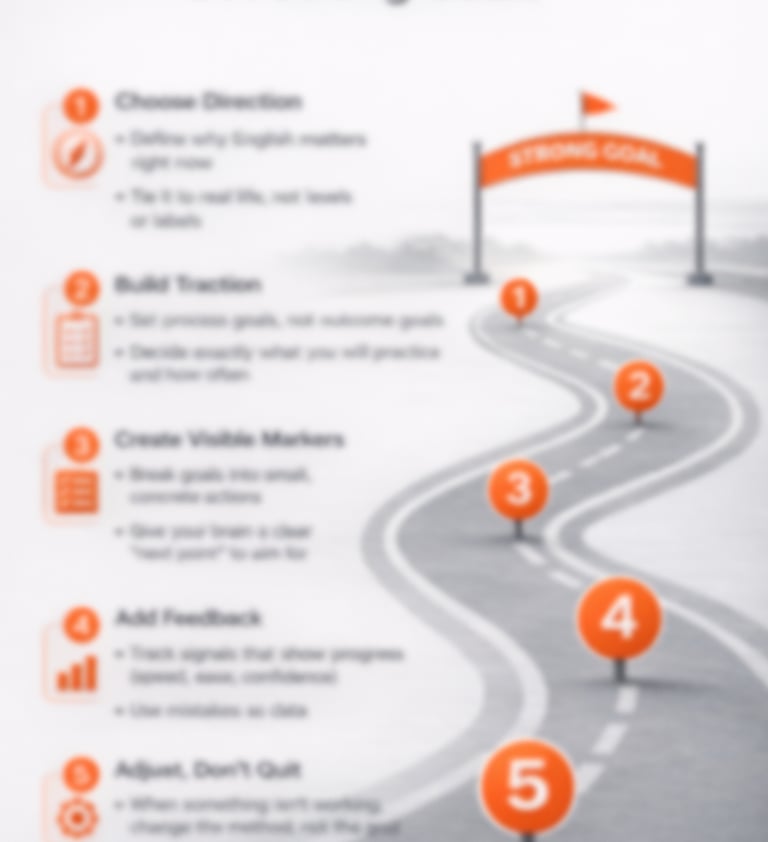
Before asking learners to commit to new goals, it helps to clarify three elements.
Direction
Why does this matter right now?
What is the learner working toward in real life, not just in terms of levels or labels?
Traction
What behaviors can be practiced consistently without friction?
Short, repeatable actions matter more than ambitious plans.
Adaptation
What signs will indicate that something needs to change?
Improved speed, smoother speech, faster recall, fewer breakdowns.
When goals are meaningful, supported by feedback, and flexible enough to evolve, time and motivation stop being the primary obstacles.
Download the Goal Design Framework (Printable)
I’ve turned this framework into a one-page visual designed for teachers. It can be used for lesson planning, goal-setting conversations, syllabus design, or professional development sessions.
No sign-up required.
Bringing It Back to You
Before you scroll away, return to the two goals you thought of at the start.
The one you followed through on.
The one you let go.
Now look at them through a different lens.
The goal that stuck probably had a clearer sense of what “done” looked like. You didn’t have to guess whether you were making progress.
Along the way, you likely noticed small signals that told you to keep going or to adjust. Not at the end. Early.
The goal that didn’t last often depended on a distant outcome. Progress was invisible until it was too late. There was no information coming back to you that said, “Yes, this is working,” or “Try this instead.”
That difference matters more than motivation ever did.
Try This Before Monday
Pick one goal your students are currently working toward.
Before adding anything new, answer this:
What signal would tell a learner this week that they are on the right track or need to change course?
Not at the end.
Not after grading.
This week.
If you cannot name a signal, neither can they.
Make one small adjustment so that signal becomes visible.
If you try this, share in the comments:
The signal you made visible
Or the moment you realized your own goal failed because there was nothing to respond to
Your example might be exactly what another educator needs to see.
References
Huberman, A. [Huberman Lab Podcast]. (2022, January 17). The science of setting & achieving goals [Video]. YouTube. https://youtu.be/t1F7EEGPQwo
Hurlock, H. (2025, December 22). The science of setting goals that last. Super Age. https://superage.com/the-science-of-setting-goals-that-last//?utm_source=superage&utm_campaign=cr20260111&utm_medium=email
<div class="powr-comments" id="a5d65f0f_1736826767"></div><script src="https://www.powr.io/powr.js?platform=html"></script>