Flex Mod Scheduling and Collective Teacher Efficacy: Rethinking the Master Schedule
Flex mod scheduling is a flexible high school model that replaces traditional periods with modular time blocks, allowing teachers to design instruction collaboratively. Research shows it significantly improves collective teacher efficacy, especially in teacher empowerment, collaboration, and goal alignment which are all key factors linked to higher student achievement.
LEADERSHIP
Jon Tomski
4/5/20266 min read


In most schools, the master schedule is something we build, adjust, and move on from. It’s often viewed as a logistical necessity rather than a strategic tool. This study takes a different approach, looking at how scheduling structures—specifically flexible modular (flex mod) scheduling—can influence school culture, teacher collaboration, and student outcomes.
At its core, flex mod scheduling is built on a simple but disruptive idea: learning improves when time and structure are flexible enough to match instructional goals.
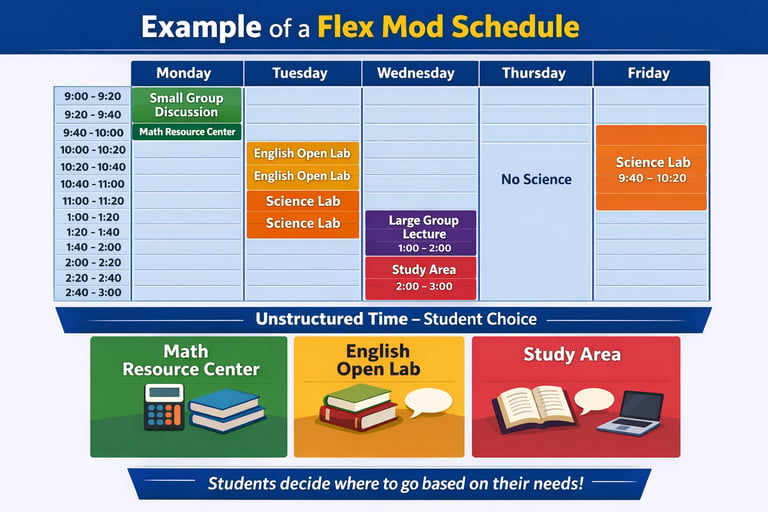
Instead of a traditional 7-9 period day, flex mod schools divide the day into 20-minute blocks (“mods”), often 21 per day. Teachers and departments then design how those mods cluster into different instructional phases. The best way to describe phasing is that it’s similar to a university schedule where, if you have a science course you’re taking at a university, depending on the day of the week it will be a different phase of that course. A single course might include:
Small group discussions
Lab-based sessions
Large group lectures
Most courses are team-taught. Teams get together and decide the way to structure their class for the year.


A System Built on Autonomy and Collaboration
Teachers often share students across phases, meaning one student might encounter multiple instructors within the same course throughout the week. let’s take science for the example again. This student may have a different teacher for each one of these phases during the week. They may have one teacher for small group, but a different one for lab, and a different one for the other lab over here. All of the teachers would likely be together in the large group setting on Wednesday. That setup eliminates the illusion of isolated classrooms and makes team teaching non-negotiable.
Consistency becomes a shared responsibility:
Teachers must align on instruction and assessment
Departments must coordinate pacing and goals
Communication becomes constant, not optional
So I always like to say Flex Mod schools were team teaching before team teaching was cool. They were doing this way back in the ’70s, before PLCs became a big thing and all that. Team teaching is a cornerstone of the Flex Mod.
Students also operate with more autonomy. Because schedules are fluid, conflicts happen, and instead of being solved administratively, they’re resolved through negotiation between students and teachers. Around 30% of students in the exemplar school (Wausau West High School) experienced scheduling conflicts, and worked them out collaboratively.
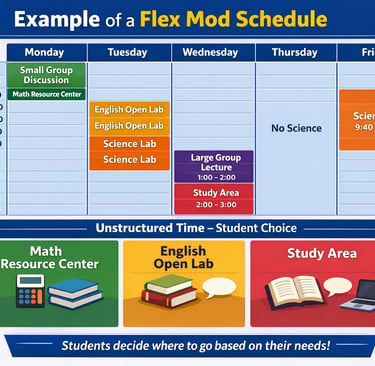
Then there’s unstructured time. Students aren’t micromanaged into every minute. Instead, they choose how to use open blocks: visit resource centers, seek help in specific subjects, or manage their own learning priorities. So each department, each content area, runs a resource center or runs what are called open labs or open resources, and students decide where they go during their unstructured time based on their needs. So if I’m a student and I’m struggling in math, and I have this nice chunk of time available on Monday, I’m going to go to the math resource center on Monday, where there will be a math teacher there to help me. It may not be my math teacher, but it is a math teacher with the expertise to help me with what I need.
In theory, this builds independence. In practice, it exposes whether students actually know how to manage themselves.

The Research Problem: Where Flex Mod Meets Collective Teacher Efficacy
Despite its potential, flex mod scheduling is oddly under-researched. Most formal studies date back to the 1970s, with very little modern analysis.
This study connects flex mod scheduling to a more contemporary concept: collective teacher efficacy (CTE), which is the shared belief among teachers that they can positively impact student outcomes.
Research has consistently shown a strong correlation between high levels of CTE and improved student achievement. The question becomes:
Can a scheduling system influence collective teacher efficacy?
To explore this, the study examined five enabling conditions of CTE (based on Donahue, Hattie, and O’Leary, 2020):
Empowered teachers
Reflective practices (collaboration)
Cohesive teacher knowledge
Supportive leadership
Goal consensus


The study used a non-experimental, quantitative design, focusing on high school teachers in self-identified flex mod schools across Wisconsin, North Dakota, and South Carolina.
Flex mod group: 153 participants
Normative comparison group: 695 participants across 16 high schools
Data came from a validated instrument measuring collective teacher efficacy, supplemented with flex mod–specific questions to capture teacher perceptions of the model.
Key Findings
Across all five subscales, flex mod schools outperformed the normative group. And not by a little.
1. Empowered Teachers
Flex mod structures significantly increased teacher autonomy. Teachers are able to shape how their courses run, adjust the flow of instruction, and make decisions that directly affect how students experience learning. This level of autonomy is built into the structure itself rather than being something that’s simply encouraged.
2. Reflective Practices (Collaboration)
Collaboration was deeply embedded into the school day, not squeezed into early mornings or after-school meetings. The schedule itself created space for ongoing dialogue and shared problem-solving.
3. Supportive Leadership
Flex mod requires administrators to step back from top-down control and adopt distributive leadership. Since teachers are responsible for designing and managing key parts of the schedule, the model only works when there is consistent trust in their professional judgment.
For the most part, of course, administrators put up the fences from within which teachers have to work and operate to schedule themselves, but on the whole, teachers have a lot of decision-making power in their schedule. So supportive leadership is necessary, and again, that is one of the enabling conditions for collective teacher efficacy studied by Donahue and colleagues.
4. Cohesive Teacher Knowledge
This was the lowest scoring area in flex mod schools, though still higher than the comparison group. Interpretation:
Teachers understand the schedule and its philosophy
Teams align within departments
But school-wide agreement on “what good teaching looks like” is less consistent
In other words, collaboration exists, but shared instructional clarity across the entire building still has gaps.
5. Goal Consensus
This was the most unexpected finding and biggest discrepancy between the Normative Group and the Flex Mod group. It was not evident in the literature. Again, most of the literature on Flex Mod was from the ’70s. That was before SMART goals and continuous improvement plans came to be, so it just wasn’t evident in the literature.
The likely explanation are constant collaboration, shared ownership of students, and strong identification with the system. When teachers believe in the structure, they also align more easily on purpose.
What This Means in Practice
The findings point to a clear takeaway: the master schedule is not just a logistical tool but plays an active role in shaping how people work together and how schools function day to day.
In a flex mod system, teachers have greater ownership over their work, collaboration becomes part of the structure rather than an added expectation, leadership is more distributed, and there is stronger alignment around shared goals.
These conditions are closely tied to collective teacher efficacy, which has already been shown in research to be associated with improved student outcomes.
Limitations
Before declaring flex mod the savior of education, a few constraints:
Small sample size relative to national scale
No centralized database of flex mod schools
Potential confounding variables (school culture, experience level, leadership quality)
Technical issues reduced usable responses
Also, this study shows correlation not causation. The schedule might drive these outcomes, or it might attract schools already predisposed to these characteristics.
Recommendations That Schools May Ignore
For educational leaders:
Treat scheduling as a strategic lever, not a logistical chore
Build collaboration into the school day, not around it
Increase teacher input to strengthen autonomy and efficacy
For flex mod schools:
Focus on improving shared understanding of effective teaching across the entire building
Leverage strong goal consensus for school improvement initiatives
For researchers:
Investigate direct links between flex mod and student achievement
Explore the role of distributive leadership in both flex and non-flex schools
Study the lived experience of teachers within flex mod systems
Final Thought
Flex mod scheduling is more than a different way of organizing time. It influences how teachers collaborate, how decisions are made, and how the school operates on a daily basis.
Teacher collaboration should be protected and prioritized in the master schedule and job-embedded. That’s not a new idea, but this research certainly affirms it as it relates to Flex Mod specifically.
Teacher input creates autonomy, which leads to teacher efficacy. So teacher input in the schedule leads to feelings of autonomy, which in turn increase efficacy, and again, this is done through a distributive leadership model in a Flex Mod building, and it really affects school culture.
In many schools, efforts to improve culture focus on initiatives, messaging, or additional meetings. What often gets overlooked is the structure that shapes how people actually work each day. The schedule plays a central role in that structure, and its impact is often underestimated.